
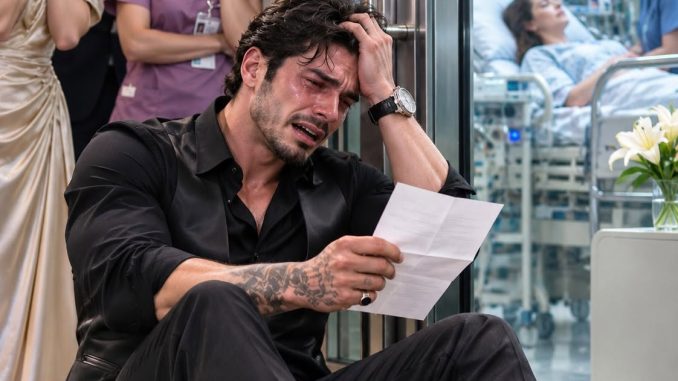
Emily Carter later told me that Vincent read my letter twice before he could speak. On the first reading, he apparently stopped at the line where I wrote that our daughter deserved a father who knew the difference between a crisis and an inconvenience. On the second, he reached the sentence that mattered most: I was asking him to let our marriage end without making me fight for permission.
“Where is Claire?” he asked, folding the pages badly, one corner crushed in his fist. Emily did not answer as quickly as he wanted. She asked him to sit down. Vincent Moretti, a man who could clear a restaurant with a raised hand, refused. Then Emily told him that I had stopped breathing during surgery and that the team had brought me back. My condition was still critical.
He asked about the baby. That was when he learned he had a daughter. She weighed less than three pounds and was in the neonatal intensive care unit, where doctors were helping her breathe. Emily would not promise him either of us would be all right. According to her, he finally sat when she said, “Your wife needed you three hours ago. What she needs now is for you to listen.”
I knew none of this when I opened my eyes. I knew only the pulling ache low in my abdomen, the dry scrape in my throat, and a monitor marking seconds I had nearly lost. A nurse noticed my fingers moving and leaned over me. I tried to ask for my baby, but what came out was a sound too small to understand.
“She’s alive, Claire,” the nurse said. “She’s being cared for upstairs. You’ve had a very serious hemorrhage. We need you to rest.” She spoke clearly, as though each word were a railing I could hold. I could not see my daughter or lift an arm. The relief of hearing she was alive broke through me so violently that I began to cry.
I had imagined meeting her differently. During the months when I could still believe our home might become gentle once a child arrived, I pictured Vincent handing her to me beside a sunlit window. I pictured a small face against my chest, a ridiculous argument about whose nose she had. Instead, my first memory of being her mother was the knowledge that I had survived long enough to ask about her.
Vincent appeared at the doorway later that evening in the same dark suit he had worn to his grandfather’s eighty-fifth birthday celebration. He had removed his tie. He looked at the machines before he looked at me. When he took one step closer, I shifted my hand beneath the blanket, trying to find the call button.
Emily was immediately beside the bed. “Mr. Moretti, she is recovering. She decides who stays.” His expression changed, but he stopped. He held the folded letter at his side. “Claire,” he said, quietly enough that I almost missed it. “I didn’t know.” I managed to turn my head. “Daniel told you,” I whispered. “You knew enough.”
He did not argue. That frightened me more than his usual anger would have. Vincent had always treated disagreement as a problem someone else needed to solve. Now he stood without an answer, looking at the woman he had once accused of being jealous because she wanted a husband who came home.
“I want to see her,” I said. Emily understood that I meant the baby. She explained that the doctors would decide when I was strong enough for transport and that, until then, the NICU could send an image if I wanted one. I nodded. Vincent offered to bring it, but I looked toward Emily instead. I needed one ordinary decision that belonged entirely to me.
Emily returned with a photograph of a tiny girl beneath a soft knitted cap, surrounded by tubing and careful hands. I studied the curve of her cheek. Her mouth was open in a furious little protest. She seemed impossibly small and astonishingly determined. I touched the edge of the paper with one finger because that was the only way I could touch her.
“She has no name on the chart yet,” Emily said. “You can take your time.” I had spent weeks considering names privately because Vincent had dismissed the conversation whenever Sophia called. “Elena,” I told her. My mother had once said the name meant a kind of light. “Her name is Elena Bennett Moretti.” Saying it made my daughter real in a way even the photograph had not.
Vincent repeated the name from the doorway. I had forgotten he was still there. His voice sounded broken. He asked whether he could visit Elena. Emily said the neonatal team would explain the requirements, but she turned to me before giving him anything. “Would that be all right with you right now?” I was exhausted, furious, and aware that Elena could not choose her parents.
“Yes,” I said. “But he doesn’t speak for me.” It was a small distinction, easily missed, yet Emily wrote it down as though it mattered. Vincent stared at the paper in my hand. “I’ll be there,” he said. I closed my eyes. “You said that before,” I answered. “This time, you have to mean it.”
After he left, the room settled around me. I was not strong enough to sit, let alone decide how to dismantle a marriage. But I could hear footsteps moving toward the elevator, and I knew where he was supposed to go. Emily offered to bring me news when he reached the NICU. I asked her to tell me what Elena needed, not what Vincent felt.
The update came an hour later. Elena was stable for the moment. Vincent had washed his hands, listened to the nurse, and stood beside the incubator without touching anything. Then he had asked whether I would allow him back into my room the following morning. Emily had told him that the question belonged to me. For once, I was going to take the night to answer it.
Leave a Reply